About Us
Enhancing your consultation and planning
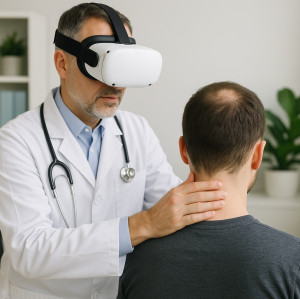
When you meet your hair restoration specialist, decisions about hairline design, donor site availability and expected yield dominate the discussion. VR can add a layer of clarity: you may be shown a three dimensional virtual model of your scalp, manipulated live to illustrate how the grafts will be distributed, how densities might vary, and where visible thinning remains. This kind of visualisation helps you set realistic expectations. You can walk around the model, see it from different angles, inspect it as though you were looking in a mirror. When you personally view the VR “before and after” scenario, you may feel more confident in what is achievable and more involved in the decision making process.
Supporting the surgical team’s training and confidence
Even if the VR tool is not used on you directly during surgery, it has a role behind the scenes. Studies show that VR and related immersive technologies enhance surgical training and procedure rehearsal. For example, a systematic review of VR, AR and mixed reality head mounted devices found that many participants improved knowledge and skills when practising in VR rather than only on traditional models. A global mixed methods study of immersive technologies in clinical settings confirmed that VR helped improve spatial awareness and procedural confidence among healthcare professionals.
That means when your surgeon or surgical assistant has rehearsed operative sequences or visualised complex donor recipient matching in VR, you may benefit indirectly. The team is better prepared, more familiar with anatomy and workflow, and less likely to be surprised by unusual donor or recipient site anatomy.
Improving patient experience and pain management
There is also emerging evidence that VR may help with pain and anxiety during scalp based dermatological procedures. One modest randomised trial found that VR distraction during scalp injections reduced discomfort for patients.
In the context of hair transplantation, this means you might wear a VR headset during the local anaesthetic phase, or have digital visualisation to distract you while the team works on graft insertion. The benefit is likely incremental rather than dramatic, but for anxious patients it may shift the experience toward one of control rather than passive discomfort.
What VR does not replace
It is vital to remember that VR augments rather than replaces the fundamental elements of a hair transplant procedure. It does not eliminate the need for donor hair assessment, surgical skill, wound management, or for your ongoing post operative care, including medications, scalp hygiene and follow up visits. As a sensible patient you must still ensure your baseline health is ready. Visit your GP for a full health check. You might uncover hypertension, cardiovascular risk factors, or scalp conditions such as seborrhoeic dermatitis or psoriasis which need stabilising before invasive procedures proceed.
Cost considerations you should know
In the UK, the cost of hair transplant surgery varies widely. For moderate sized areas you might expect around £3,000 to £4,000. Larger procedures or multi session plans may exceed £10,000. Using VR during consultation may add a modest premium to your treatment package, perhaps a few hundred pounds depending on the clinic. The key point is that this is an optional enhancement, not a substitute for essential surgery and care.
Questions you should ask your surgeon or clinic
- How many grafts and what cost does this session cover, and what additional cost might be incurred if you need more later?
- Are you comfortable that your general health, via your GP, is suitable for surgery?
- What is the expected recovery timeline and what happens if your natural hair loss continues despite surgery?
Why My Hair UK takes this seriously
At My Hair UK we believe that your informed participation matters. When you see a VR model of your proposed outcome you engage more meaningfully in planning. We have found that patients who view a VR demonstration ask deeper questions about graft density, donor hair reserve and follow up care. Data suggests that better informed patients feel less regret and are clearer about realistic outcomes.
Final thoughts for you
If you are considering a hair transplant procedure to help treat hair loss you can view VR not as a gimmick but as a way to deepen your understanding of what lies ahead. You still need to:
- visit your GP for a full health check
- gain clarity on cost and number of grafts
- understand that VR enhances the process but does not replace the fundamentals of surgical care
- set realistic expectations for outcome, based on your hair loss pattern and donor reserve. A summary of contemporary hair transplantation technique is found in Queen and Avram, 2025.
Related Articles:
Using Augmented Reality in the Hair Transplant Process
A Guide to Before and After a Beard Transplant
Alopecia types and how they can be treated in Leeds
Combining Low-Level Laser Therapy with Hair Transplant